

Long Term vs Short Term Rental in Kissimmee — Which Makes More Money in 2026?
Revenue: STR Usually Wins — But Not Always
For most properties in the Kissimmee and Davenport resort corridor, short term rental income significantly exceeds what the same property would generate as a long term rental.
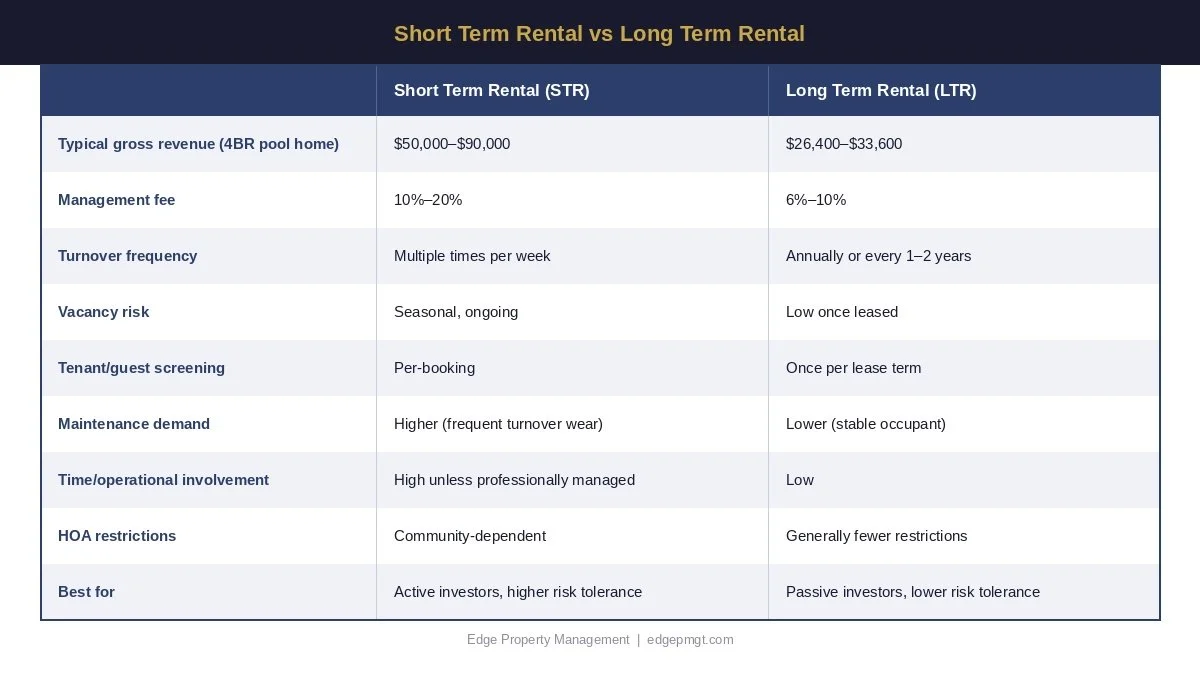
A well-managed four bedroom pool home at ChampionsGate generating $80,000 per year in STR revenue would likely rent for $2,200 to $2,800 per month as a long term rental — generating $26,400 to $33,600 annually. The STR premium is typically 2 to 3 times the LTR equivalent for resort community properties.
However, this comparison needs to account for the higher operating costs of STR: management fees (typically 10-20% for STR versus 6-10% for LTR), cleaning between every guest stay rather than once per lease, higher maintenance demand from frequent turnover wear, consumables that LTR tenants supply for themselves, platform fees, and higher vacancy risk during seasonal slow periods. Net revenue after all costs is closer than gross revenue suggests — but STR still typically wins on net income for well-managed properties in purpose-built resort communities.
Risk: LTR Is Lower Risk
STR risks: Revenue seasonality, market-level competition from new STR supply, platform policy changes, regulatory risk as enforcement tightens across Florida markets, and higher operational complexity.
LTR risks: Tenant quality and the difficulty of screening effectively, lower revenue ceiling, and the tenant eviction process in Florida if problems arise, which can take weeks to months and carries real holding costs during that period.
For owners who want predictable, hands-off income with minimal operational involvement and lower month-to-month volatility, LTR is the lower-risk choice. For owners willing to use professional management to handle STR's operational complexity, the revenue premium makes STR the stronger financial choice in most Disney corridor resort communities.
HOA Rules Often Decide the Question Before Revenue Does
Not all resort communities permit both STR and LTR, and in some cases the decision is made for you before revenue ever enters the conversation. Always verify HOA rules for both rental types directly before purchasing, rather than assuming a property's STR potential based on its location in a "vacation rental area" generally.
The Hybrid Option
Some owners in the Disney corridor alternate between STR during peak demand periods and medium-term rentals (30 to 90 days) during slower periods. This approach can maintain high overall occupancy while reducing the operational intensity of full STR management during shoulder months.
Which Strategy Fits Your Situation
If you live near your property, have time to manage actively or budget for full-service management, and want to capture the strongest possible revenue from a Disney corridor property with strong amenities, STR is generally the stronger financial choice. If you want a more passive, predictable investment with less month-to-month involvement and are comfortable with a lower revenue ceiling in exchange for that stability, LTR remains a reasonable and legitimate strategy.
Edge manages both STR and LTR properties and can advise on the right model for your specific situation, including a direct revenue comparison for your actual property rather than market averages alone.